What is pre-seed VC investing?
What is pre-seed VC investing?
1. Introduction to Pre-Seed Capital
Pre-seed venture capital investing represents the foundational layer of institutional startup financing. Positioned immediately before the traditional seed stage, it provides the vital runway required for early-stage founders to transform a conceptual hypothesis or rough prototype into a viable, market-tested business enterprise. At this phase, the primary objective shifts away from optimizing unit economics toward proving the core concept, assembling the founding team, and validating a clear problem-solution fit.
2. Core Focus Areas at the Pre-Seed Stage
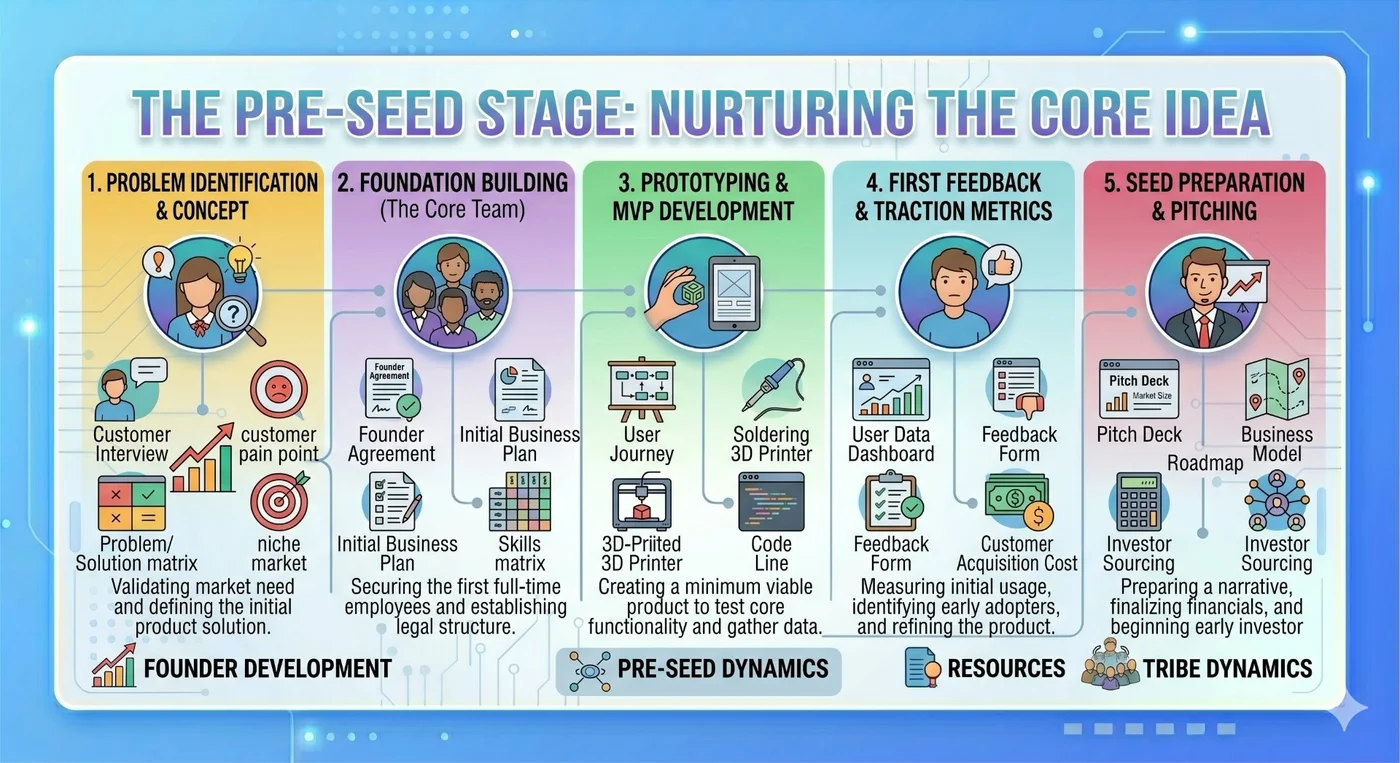
- Problem Identification & Concept Validation: Engaging in customer interviews, building user journey maps, and defining a clear problem/solution matrix for a designated niche market.
- Foundation Building: Establishing formal founder agreements, legal entities, and securing the first full-time employees or technical co-founders.
- Prototyping & MVP Development: Designing wireframes, conducting early code sprints, or building an initial minimum viable product (MVP) to gather qualitative feedback.
- Early Traction Metrics: Tracking initial user usage, feedback forms, and measuring preliminary signs of product-market fit.
3. Comparative Matrix: Pre-Seed vs. Seed Stage
| Feature | Pre-seed Stage | Seed Stage |
|---|---|---|
| Core Strategic Objective | Proving the concept, building the core product, and validating market demand. | Proving the economic engine, scaling early traction, and optimizing distribution channels. |
| Cell | Cell | Cell |
| Cell | Cell | Cell |
| Cell | Cell | Cell |
| Cell | Cell | Cell |
4. Evaluation Metrics for Pre-Seed Investors
Because historical financial data and concrete revenue sheets are virtually non-existent at this stage, pre-seed venture capitalists rely heavily on a distinct set of evaluation pillars:
- Founder Execution Capability: Assessing the core team’s domain expertise, complementary technical or commercial skill matrices, and resilience.
- Market Velocity & TAM: Evaluating the Total Addressable Market (TAM) to ensure the startup is building in a sector with room for exponential venture-scale expansion.
- Strategic Roadmap: Reviewing the pitch deck, financial modeling assumptions, and early roadmap to determine how effectively the team intends to deploy capital to reach their next institutional milestone.