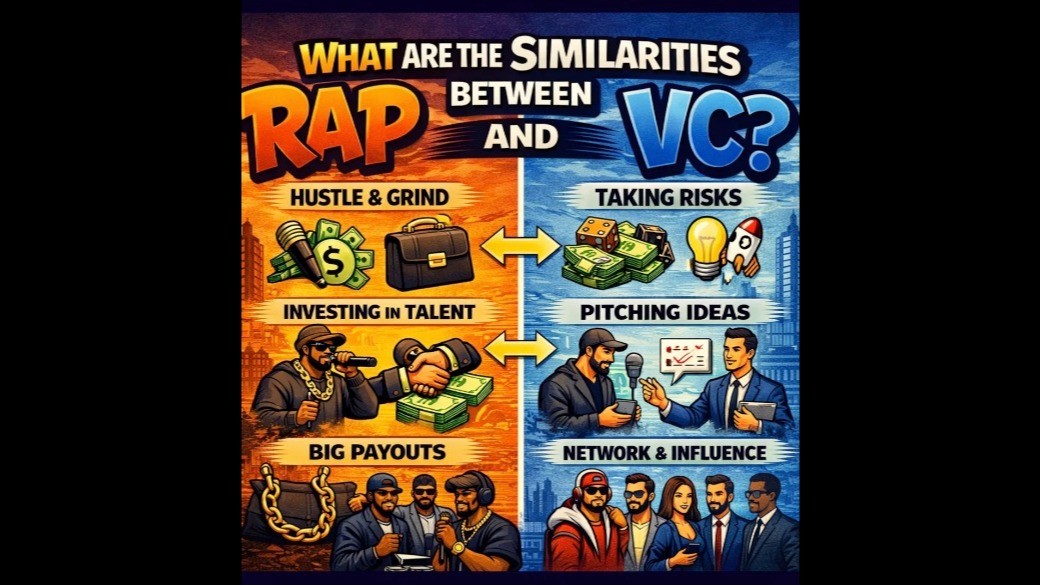
OG: What do rap and VC have in common?
More than you'd think — and probably more than either side wants to admit.
Walk into a top-tier VC firm and you'll find a room full of people who believe they can spot the future before anyone else does. Walk into the booth with a hungry rapper and you'll find exactly the same delusion — and exactly the same hunger. One bet on companies. The other bets on words. Both are, at their core, in the business of conviction.
At first glance the comparison seems like a stretch. Venture capital is spreadsheets, cap tables, and Sand Hill Road. Hip-hop is cyphers, mixtapes, and the corner. But zoom out and the silhouette is the same: a hyper-competitive ecosystem where almost everyone fails, the winners take everything, and the entire enterprise runs on reputation, relationships, and an almost irrational belief in your own taste.
"Both industries are obsessed with the same three things: who co-signed you, who you came up with, and whether you can back up the talk."
1. The portfolio mindset
Every rap label worth its name runs a portfolio. Def Jam under Russell Simmons wasn't a hunch — it was a thesis: raw urban music would cross over, and they needed enough bets on the table to be right at scale. LL Cool J was the anchor. Public Enemy was the moonshot. EPMD was the steady compounder. Sound familiar?
VCs think the same way. Sequoia doesn't expect every portfolio company to be Apple. They need one or two to return the fund, a handful to return capital, and the rest are learning. The math of venture and the math of a rap roster aren't just similar — they're structurally identical. Power law distributions don't care what industry you're in.
2. The co-sign is currency
In rap, the co-sign is everything. Jay-Z's Reasonable Doubt moved because Dame Dash forced it into every record store in New York and DJ Clark Kent played it at every party. Lil Wayne put Drake on So Far Gone before Drake was Drake. The co-sign doesn't just open doors — it transfers credibility from someone who has already earned it to someone who hasn't had the chance to prove it yet.
In VC, this is called warm introductions and board composition. A term sheet from Benchmark or a16z doesn't just mean money — it means signal. It tells every subsequent investor, every potential hire, every future customer that someone who sees thousands of deals per year thought yours was worth backing. The mechanics are the same. The psychology is identical.
3. Authenticity as moat
Here's where it gets philosophically interesting. Rap has one commandment above all others: be real. The worst thing you can be called in hip-hop is a fraud — someone performing a life they haven't lived, spitting bars about struggles they never faced. The culture polices this ruthlessly. Your story is your product, and if the story is fake, no amount of production quality saves you.
Venture capital has the same taboo, wearing different clothes. The most dangerous thing a founder can do is misrepresent their metrics, their team, or their market to investors. But it goes deeper than that. The best VCs and the best operators share something with the best rappers: genuine conviction. They back things they actually believe in. When they're performing conviction they don't feel, the market eventually finds out — and the streets remember.
"Authenticity isn't a nice-to-have in either game. It's infrastructure. Everything else — the deals, the drops, the dollars — sits on top of it."
4. The OG advantage
OG means Original Gangster. But in practice, what it really means is someone who was there before it was cool, paid real dues, and survived long enough to accumulate wisdom. The OG doesn't need to prove themselves anymore. Their presence in the room changes the room.
Venture has the same archetype. The Don Valentines, the Mike Moritzes, the Doug Leones — people whose track record is so deep that founders compete to take their money even when better terms are on the table. In rap, Ice-T doesn't need to outsell the new generation. His longevity is the credential. In VC, that's called a brand fund — where the firm itself has become the product.
Both systems reward durability over flash. The one-hit wonder in rap and the one-deal wonder in VC share the same fate: they get talked about in the past tense.
5. The culture creates the market
Perhaps the deepest parallel is this: in both worlds, the players don't just participate in a market — they define one. Hip-hop didn't slot into existing music industry structures. It broke them, created new distribution channels (radio stations, mix CDs, SoundCloud), new revenue streams (touring, merch, beats licensing), and new taste-making institutions. The culture was the product.
The best VC firms operate the same way. They don't just find promising companies in existing industries. They actively construct the conditions for new industries to emerge. They fund the infrastructure, the platforms, the picks-and-shovels plays that make the broader ecosystem possible. Andreessen Horowitz didn't just back tech companies — they rewrote the narrative around what tech founders should look like, how they should operate, and what they deserved.
That's an OG move. Define the game before others know there's a game to play.
So what?
None of this is to glamorise venture capital by borrowing hip-hop's credibility, or to reduce hip-hop to a business framework. Both of those moves would be annoying and wrong.
The point is simpler. Both worlds select for the same rare combination of traits: pattern recognition, risk tolerance, relationship intelligence, and the ability to stay true to a vision when everyone around you thinks you're wrong. Both worlds ruthlessly punish fakery and reward longevity. Both operate as reputation economies where trust compounds over time.
If you're building in either space, the lessons translate. Build real relationships before you need them. Get the co-sign from someone whose judgment the market respects. Play a long enough game that the word OG starts to feel plausible.
And never, ever fake the funk.
Full disclosure. I used AI to gen this blog. I was riffing on OG VC and the similarities in music and film investing and AI jumped in and fleshed it out. Thanks to AI for the graphic as well. Shazza, none of this is copyrighted! Living my best AI life as an OG startup dude from the 90's turned VC in the 20's. YOWZA!