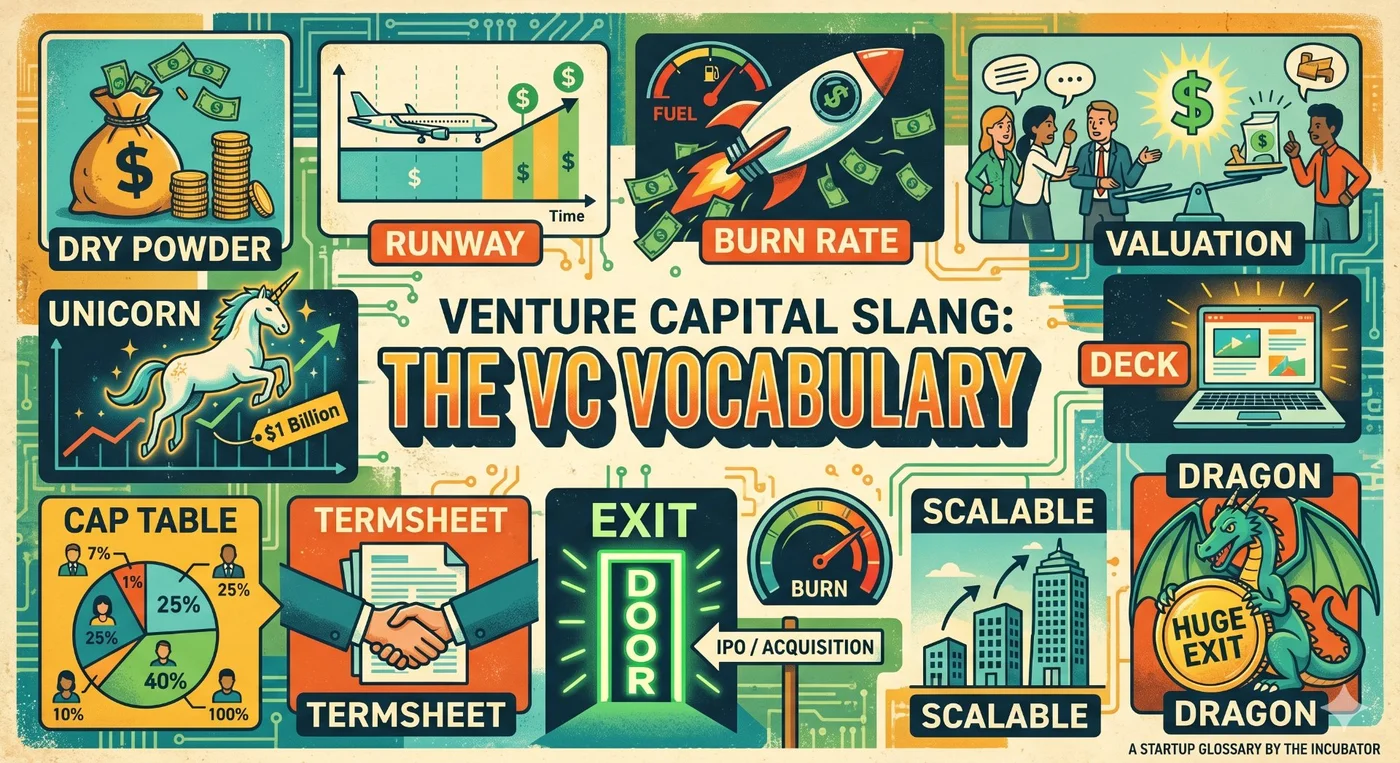
VC Slang
ARR: Annual Recurring Revenue — the annualised value of a company's recurring subscription revenue, used to measure predictable SaaS growth.
Burn rate: the rate at which a startup spends its cash reserves, typically measured monthly. Gross burn is total spending; net burn is spending minus revenue.
CAC: Customer Acquisition Cost — the total cost to win a new customer, including all sales and marketing spend divided by the number of customers acquired.
Cap table: Capitalisation table — a spreadsheet tracking the ownership stakes, share classes, equity dilution, and value of equity held by founders, employees, and investors.
Ceiling: the maximum valuation or market size a company can realistically achieve given its market, business model, and competitive dynamics.
Corn: a nice vegetable that tastes like corn :-)
Dead cat bounce: a temporary, short-lived recovery in the price of a declining asset — followed by a continuation of the downtrend. It comes from the grim idea that "even a dead cat will bounce if it falls from high enough" — meaning a small rebound doesn't mean something is actually alive or recovering.
Decacorn: a private tech startup that is valued at $10B or more.
Dry Powder: similar to runway, what resources are left to apply to the business and its challenges.
Flipup: when a company moves their headquarters company registration to another country, very typical when startups flip up to the US as Delaware C companies.
Forward deployed engineer: a software engineer embedded directly with a customer to build, customise, and solve technical problems on-site — a model popularised by Palantir.
IPO: Initial Public Offering — the first time a private company sells shares to the general public on a stock exchange, transitioning from private to public ownership.
LTV: Lifetime Value — the total revenue a business can expect from a single customer account over the entire duration of that relationship.
LTV to CAC ratio: a unit economics metric comparing the lifetime value of a customer to the cost of acquiring them. A ratio of 3:1 or higher is generally considered healthy for a SaaS business.
MRR: Monthly Recurring Revenue — the normalised, predictable monthly revenue generated from active subscriptions or contracts.
Multiple: a valuation shorthand expressed as a multiple of a key metric, most commonly revenue or EBITDA (e.g. "trading at 10x ARR"), used to compare companies within a sector.
MVP: minimum viable product, when the product is good enough someone will use it and potentially pay for it.
Nous: smarts, know how.
Outlier: similar to an outlier in a dataset, refers to a founder which is atypical or above average.
Pareto logic: reasoning or decision-making based on the 80/20 rule, named after Italian economist Vilfredo Pareto. Roughly 80% of outcomes come from 20% of causes. The logic that flows from this observation is: identify and focus on the vital few inputs that drive most of the results.
Pre-seed: the earliest stage of startup funding, typically from founders, friends, family, or angel investors, used to validate an idea before a formal seed round.
Product led growth: the idea that the product sells itself with very little or no human sales effort.
Product market fit: when it's clear that customers — typically many — will pay to use the product.
Red herring: the term "red herring" for an S-1 (a company's IPO registration statement) comes from the literal red ink disclaimer printed on the cover of the preliminary prospectus. The phrase already existed in English as an idiom meaning something misleading or a false lead (from the practice of dragging a smelly fish across a trail to throw off hunting dogs). The preliminary prospectus borrowed the term because, like a red herring, it's not the real thing — it's a teaser that can mislead you into thinking the deal is done when it isn't.
Runway: the number of months a company can continue operating at its current net burn rate before exhausting its cash reserves.
Sand Hill Road: a street in Menlo Park, California that is home to many of the world's most prominent venture capital firms; widely used as a metonym for the VC industry as a whole.
Secondary: a transaction in which existing shareholders — founders, employees, or early investors — sell their shares to new investors, rather than the company issuing new shares.
Seed: the first significant round of institutional funding, typically used to hire an initial team, build a product, and find early product-market fit.
Series A, B, C…: successive rounds of institutional venture capital funding, each typically at a higher valuation as the company hits new growth milestones and scales operations.
Soonicorn: when a private tech company is likely to be valued at $1B or more at the time of securing another investment round or making a public offering.
That dog won't hunt: the business or product is not likely to succeed, something doesn't add up.
Unicorn: when a private tech startup is valued at $1B or more.
Valuation: the estimated monetary worth of a company. Pre-money valuation is before new investment; post-money is after. Often negotiated rather than calculated from first principles at early stages.