The Neural Network Guide
The Neural Network Architecture Guide: Choosing the Right Engine for Your AI Ambitions
In the current "agentic" era of AI, we often focus on the output—the chat response, the generated image, or the autonomous workflow. However, for founders, investors, and engineers, the real value lies in understanding the underlying architecture. Choosing the wrong neural network is like putting a tractor engine in a race car: it might move, but it won't win.
Here is a breakdown of the most influential neural network architectures, their cost-benefit trade-offs, and where they are actually delivering ROI today.
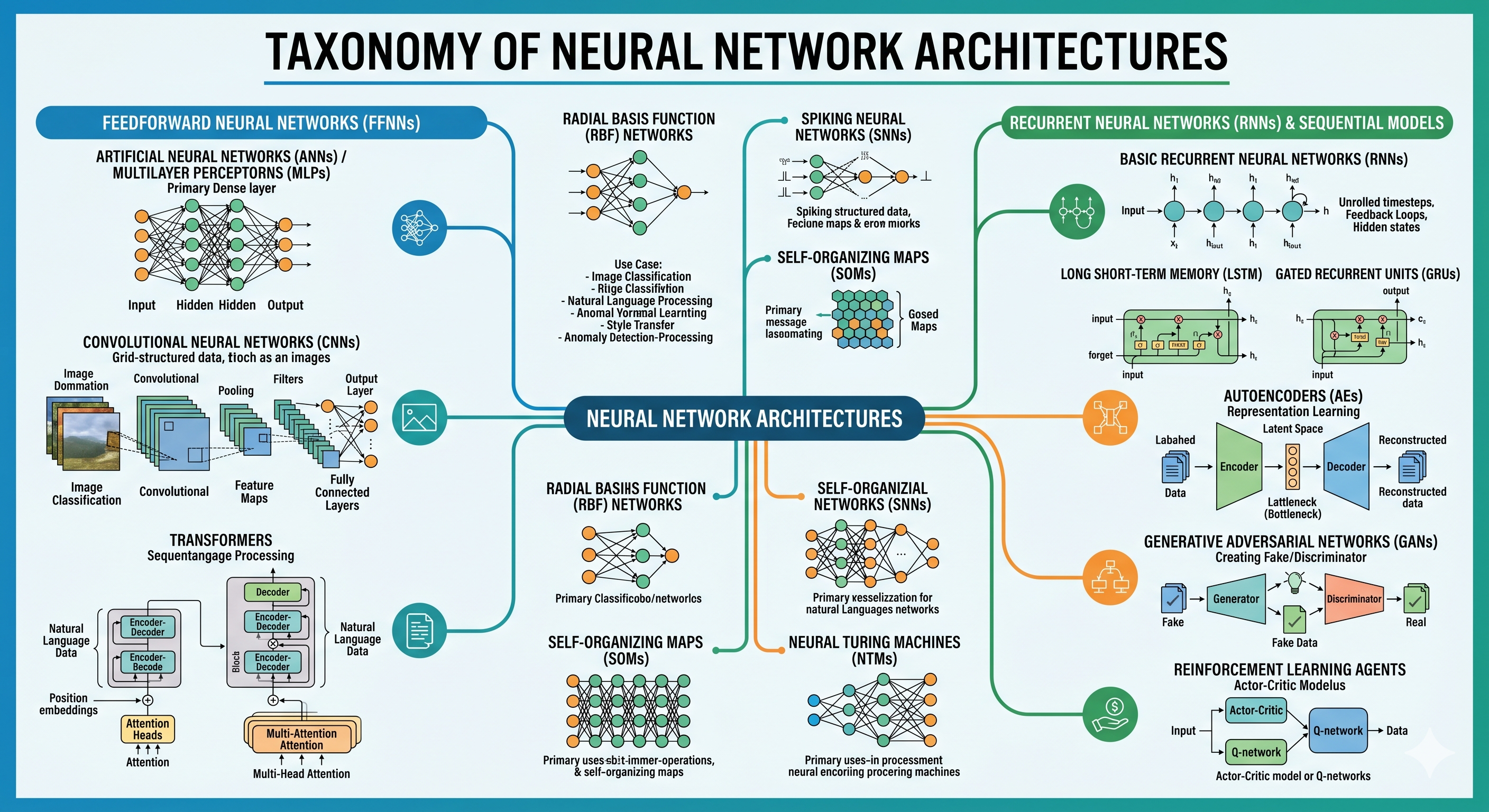
1. Convolutional Neural Networks (CNNs)
The Visual Specialists
CNNs are designed to process pixel data. They use "filters" to identify patterns—starting with simple edges and building up to complex objects like faces or cars.
Benefits: Highly efficient at spatial pattern recognition; requires fewer parameters than a standard network for image tasks due to weight sharing.
Costs: High computational requirements for training on large datasets; "black box" nature makes it hard to explain why a specific feature was flagged.
Popular Applications:
- Medical Imaging: Identifying anomalies in X-rays or MRIs.
- Autonomous Vehicles: Real-time object detection and lane tracking.
- Retail: Automated checkout systems and visual search.
2. Recurrent Neural Networks (RNNs) & LSTMs
The Sequential Historians
Unlike standard networks, RNNs have "memory." They take information from prior inputs to influence the current input, making them ideal for data that comes in a specific order.
Benefits: Excellent for time-series data and any information where context from the immediate past matters.
Costs: Prone to the "vanishing gradient" problem (they "forget" long-term context); computationally expensive to train because they cannot be easily parallelized.
Popular Applications:
- Financial Services: Stock market trend analysis and fraud detection.
- Speech Recognition: Powering voice-to-text engines.
- Supply Chain: Demand forecasting based on historical cycles.
3. Transformers
The Contextual Titans
The architecture behind GPT and modern LLMs. Transformers use "attention mechanisms" to weigh the significance of different parts of the input data, regardless of their distance from each other.
Benefits: Can be trained in parallel (massively faster than RNNs); captures long-range dependencies and nuances in data better than any other architecture.
Costs: Massive memory and energy requirements; requires specialized hardware (H100s/B200s) to run efficiently at scale.
Popular Applications:
- Generative AI: Content creation, coding assistants, and automated legal discovery.
- Translation: High-fidelity, real-time language translation.
- Drug Discovery: Predicting protein folding and molecular interactions.
Cost-Benefit Summary Table
| Architecture | Best For | Training Cost | Inference Speed | Key Strength |
|---|---|---|---|---|
| CNN | Images/Video | Medium | Fast | Spatial Awareness |
| RNN/LSTM | Time-Series | Low–Medium | Moderate | Sequential Memory |
| Transformer | Text/Complex Patterns | Very High | Variable | Global Context |
Which One Should You Build On?
The "vibe" in the market right now is to throw a Transformer at every problem. While Transformers are incredibly versatile, they are often overkill for narrow, specialized tasks.
- If you are building a tool for predictive maintenance on factory hardware, an RNN or LSTM is likely your most cost-effective path.
- If you are auditing satellite imagery for climate tech, a CNN remains the gold standard.
- If you are building autonomous agents that need to reason through complex workflows, the Transformer is non-negotiable.
The Bottom Line: In venture and product development, technical debt starts with architectural misalignment. Understand the "why" behind the network before you commit the compute.