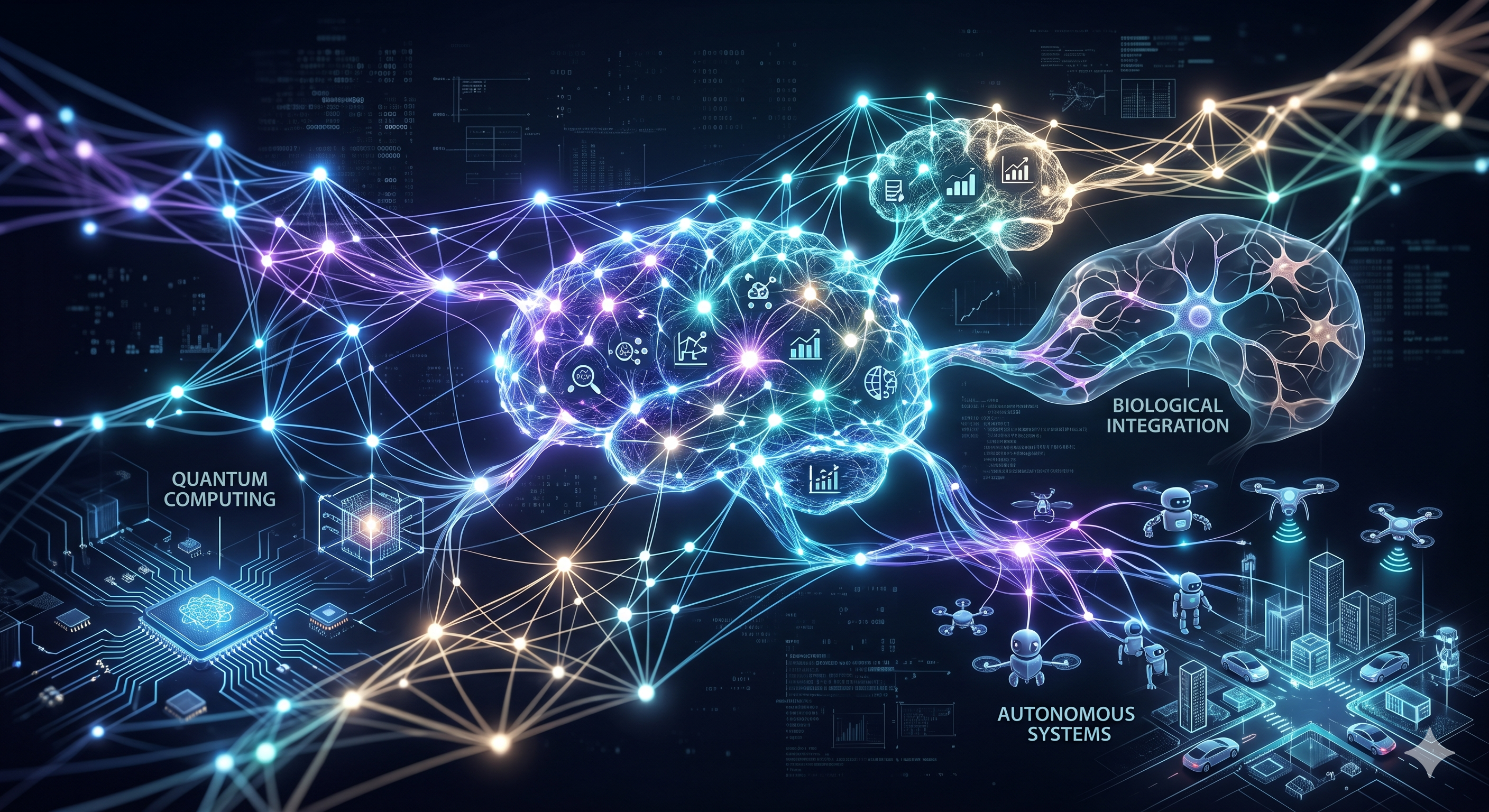
The Future of Neural Networks
By 2036, we will likely look back at the current "Transformer Era" as the era of "Brute Force" AI. While today's models rely on massive scale and energy-intensive data centers, the next decade will move toward Architectural Elegance and Physical Integration.
Here is a look at what the state of the art (SOTA) will likely be in 10 years.
1. Beyond Transformers: World Model Architectures
While Transformers excel at predicting the next word, they struggle with the "physical common sense" a child possesses. By 2036, SOTA will shift toward JEPA (Joint-Embedding Predictive Architecture) and System 2 Neural Networks.
The Shift: Moving from "Generative" (predicting pixels/text) to "World Modeling" (predicting the consequences of actions in a physical or logical environment).
Benefit: These networks won't just "chat"; they will reason and plan, understanding that if you drop a glass, it will shatter—without needing to see 10,000 videos of it first.
2. Liquid & Continuous Neural Networks
Today's networks have "frozen" weights after training. In 10 years, Liquid Neural Networks (based on differential equations) will likely be standard for time-series and autonomous systems.
The Tech: Their parameters change dynamically based on the input they receive during inference.
Application: A self-driving car or drone that adapts its "neural logic" instantly to heavy rain or a broken sensor, rather than relying on fixed training data.
3. Neuromorphic & Spiking Dominance (The "Edge" Revolution)
By 2036, we will hit the "Energy Wall" of traditional GPUs. State-of-the-art for robotics and wearables will be Spiking Neural Networks (SNNs) running on Neuromorphic Chips.
Efficiency: We are looking at "Always-on" AI that consumes milliwatts, allowing for sophisticated local agents in everything from glasses to medical implants.
The State of Play: Data centers will still use "Dense" ANNs for massive discovery, but the world will run on "Sparse" Spiking networks.
4. Quantum-Neural Hybrids
By the mid-2030s, we expect the first practical Quantum Neural Networks (QNNs) for specific high-complexity domains.
The Breakthrough: Using quantum entanglement to represent complex correlations that would take a classical network trillions of parameters to map.
Primary Use: Molecular biology (designing new materials), high-frequency financial modeling, and breaking current encryption standards.
Comparative Forecast: 2026 vs. 2036
| Feature | 2026 SOTA (Today) | 2036 SOTA (Future) |
|---|---|---|
| Primary Logic | Statistical Correlation | Causal Reasoning / World Models |
| Energy Profile | High (Gigawatts) | Hybrid (High Cloud / Low Edge) |
| Learning Style | Pre-trained & Static | Continuous & On-device |
| Hardware | GPU / HBM Memory | Neuromorphic / Optical / In-Memory |
| Data Reliance | Internet-scale Text/Image | Multimodal / Synthetic / Interaction |
The "Sovereign AI" Trend
One significant non-technical shift will be Local Autonomy. In 10 years, the SOTA won't just be the largest model in a Google or OpenAI lab; it will be the Personal Model that lives locally on your hardware, trained on your private data, operating entirely behind your own firewall.
For those in the investment or startup space, the 2030s will be defined by "Intelligence per Watt" rather than just "Total Parameters." The winners will be those who can shrink "God-like" reasoning into "Device-level" hardware.