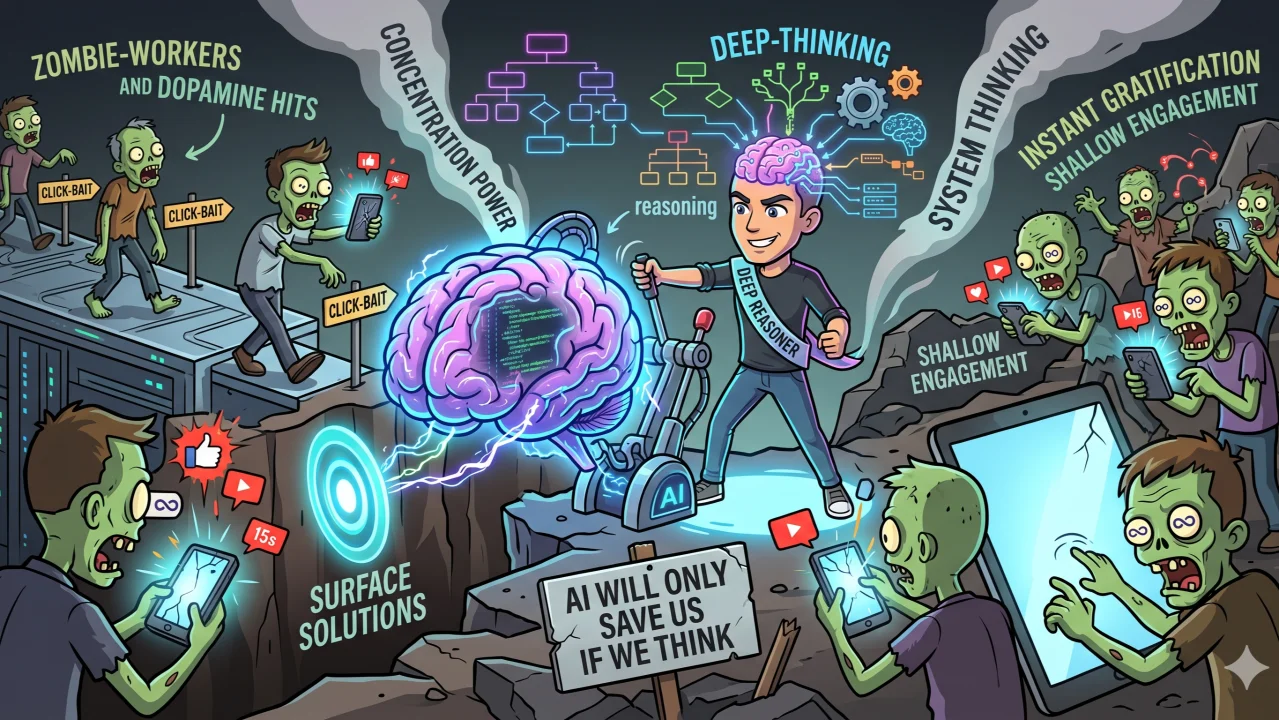
The AI Paradox: Why the Future of Tech Belongs to Deep Thinkers, Not Fast Swipers
We’ve all heard the prediction: “AI will replace entry-level workers.”
But if you look closer at the emerging infrastructure of the agentic internet and AI-driven workflows, the reality is much more nuanced. AI isn’t just replacing tasks; it’s shifting the exact type of human cognitive capital the market values.
And right now, we are facing a massive cultural bottleneck. The Shifting Talent Landscape For the last decade, early-career professionals—particularly the digital-native Gen Z demographic—have been conditioned by an internet economy built on short-form content, instant gratification, and continuous micro-doses of dopamine. Success on social platforms means mastery of the quick swipe, the 15-second hook, and surface-level engagement.
But when it comes to the future of work, that exact cognitive loop is a liability.
Why? Because AI is incredibly good at the shallow stuff. If a task can be optimized by a quick iteration or a surface-level summary, an LLM or an automated agent can already do it faster, cheaper, and at scale.
The real premium is moving upstream.
The Rise of the "Deep Reasoner"
As we transition from basic chatbots to autonomous AI agents that handle end-to-end execution, the role of the human operator changes drastically. We are moving from "doers" to "architects" and "auditors."
To thrive in an AI-augmented environment, professionals need a specific set of cognitive skills that short-form media actively erodes:
Sustained Concentration: The ability to sit with a complex, multi-layered problem for hours without checking a phone or seeking a distraction.
Deep Structural Reasoning: Understanding the second- and third-order consequences of an AI’s output. If an AI agent builds a financial model or generates a code base, the human needs the depth to spot the subtle, systemic flaw that ruins the entire architecture.
First-Principles Thinking: AI predicts the next logical step based on existing data. Human workers must provide the creative leaps and foundational truth checks that data alone cannot generate.
The New Competitive Advantage is Attention
If your primary skill is clicking, swiping, and synthesizing surface-level data, you are competing directly with a technology that updates every week.
The ultimate competitive advantage in the next decade isn't knowing how to prompt an AI—it’s possessing the cognitive stamina to direct it, audit it, and reason through the complex logic it outputs.
For founders, investors, and leaders, the hiring mandate is shifting. We shouldn't just look for "tech fluency." We need to look for depth. We need to hire for the rare, premium ability to focus intensely on complex systems without needing a dopamine hit every ninety seconds.
The tools are getting faster, which means the humans using them need to think slower, deeper, and more critically.
Are we training the next generation to handle that depth, or are we letting the algorithms optimize away our capacity to concentrate?
#ArtificialIntelligence #FutureOfWork #VentureCapital #Leadership #GenZ #TechTrends