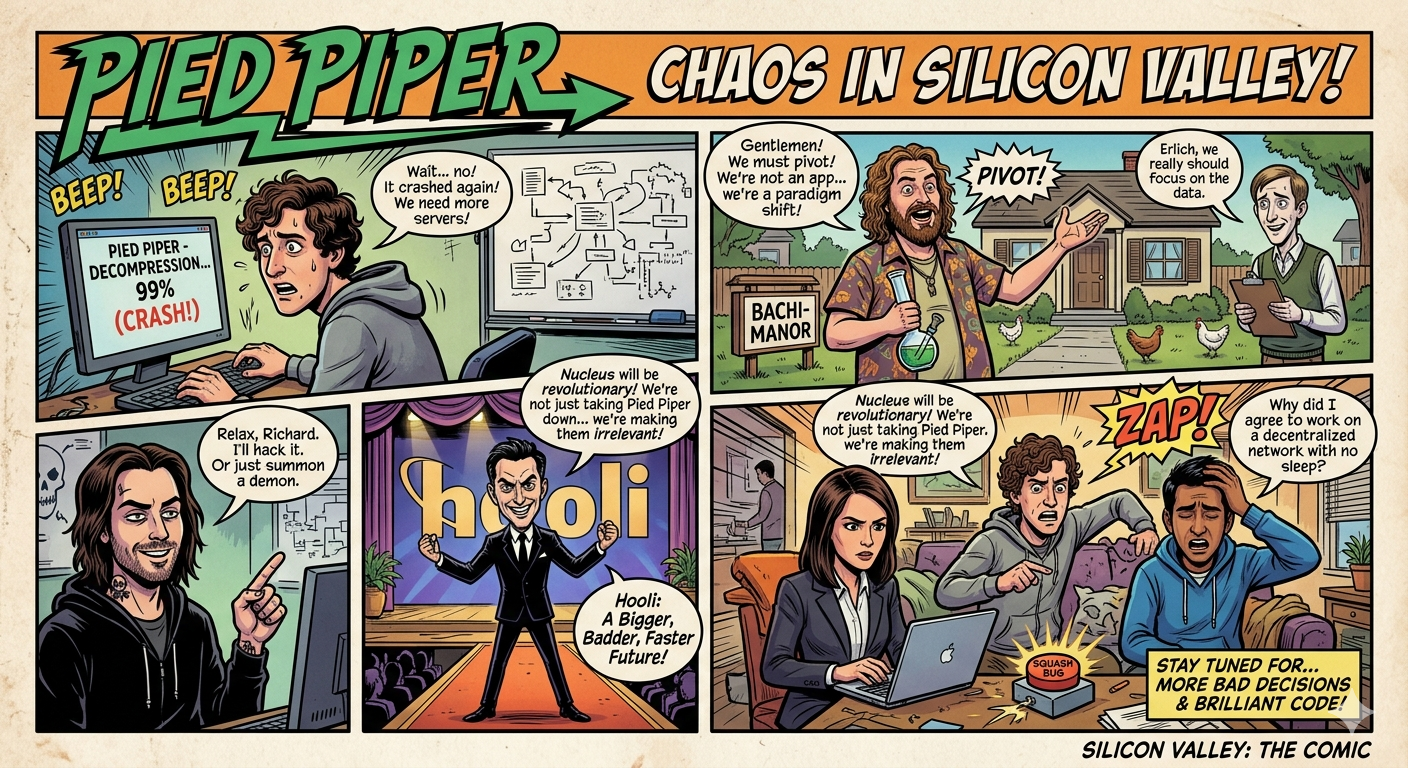
Silicon Valley TV Series Redux
The "Blood Boy" (Season 4)
In one of the show's more unsettling arcs, Gavin Belson employs a "blood boy"—a young, fit athlete whose blood is transfused into Gavin to prevent aging.
- The Real Inspiration: This is based on parabiosis research. Specifically, a startup called Ambrosia actually offered young blood transfusions for $8,000. Billionaire Peter Thiel also famously expressed interest in the practice, leading to widespread rumors (which he later downplayed) that inspired the Gavin Belson character.
The Peter Gregory "Sesame Seed" Speech (Season 1)
The eccentric venture capitalist Peter Gregory gives a brilliant, rambling speech about how the different types of seeds on Burger King buns represent a massive play in the global commodities market.
- The Real Inspiration: This was inspired by Paul Graham, the founder of Y Combinator, and the late Peter Thiel. Both are known for having idiosyncratic, "contrarian" views on education and global economics. The specific scene captured the hyper-fixation on "big data" and finding patterns where others see lunch.
The "Hooli-Search" Result Manipulation (Season 3)
Gavin Belson orders his team to scrub the internet of negative news about himself and Hooli, effectively manipulating search results to "clean" his image.
- The Real Inspiration: This mirrors a real-life controversy involving Google and European "Right to be Forgotten" laws, as well as allegations that search engines have historically tweaked algorithms to suppress unfavorable news about their parent companies or political interests.
The "Brain Drain" and the Tech Bus Protests (Season 1)
Early in the series, we see the intense tension between the tech workers riding private luxury shuttles and the local residents of San Francisco.
- The Real Inspiration: The "Google Bus Protests" of 2013–2014 were a major flashpoint in the Bay Area. Protesters blocked private tech shuttles, seeing them as symbols of gentrification and the widening wealth gap. The show captured the awkwardness of engineers trapped behind tinted glass while being shouted at by their neighbors.
The "Homicide" Energy Drink Crisis (Season 2)
The Pied Piper team ends up working in an office covered in branding for a terrifying-looking energy drink called "Homicide" after a deal goes sideways.
- The Real Inspiration: This was a nod to the era of hyper-aggressive marketing in tech, but specifically referenced the brand Monster Energy and the defunct Cocaine energy drink. It also poked fun at how startups will take "vulture" capital or sponsorship from anyone when they are desperate for a runway.
The "Nucleus" vs. "Pied Piper" Legal Battle (Season 2)
Much of Season 2 involves a lawsuit claiming Richard Hendricks developed Pied Piper while working at Hooli, using Hooli equipment.
- The Real Inspiration: This is a classic Silicon Valley trope, but the most direct parallel is the Waymo (Google) vs. Uber lawsuit. Anthony Levandowski was accused of stealing trade secrets from Google’s self-driving car project to start his own company, which Uber later bought. The "Intellectual Property" clause in employment contracts is the bogeyman of every real-life developer.
The "Human Heater" / Tech Gimmicks (Various)
The show often features useless or dangerous hardware, like the "Human Heater" that nearly catches fire.
- The Real Inspiration: This lampooned the Juicero, the infamous $400 juicer that did nothing a human hand couldn't do, and the Samsung Galaxy Note 7, which was banned from flights because the batteries were literally exploding.
The "Three Commas" Club
Russ Hanneman’s obsession with being a billionaire (having three commas in his net worth) and his "car that has doors that go like this" (butterfly doors).
- The Real Inspiration: Russ is a composite of several "loud" tech personalities, most notably Mark Cuban. Cuban famously made his billions by selling Broadcast.com to Yahoo at the peak of the dot-com bubble—essentially "winning" the lottery before the crash, much like Russ did with "putting radio on the internet."
The Origins of Silicon Valley
The series, which ran for six seasons (2014–2019) on HBO, was born from the real-life experiences of its creator, Mike Judge (also known for Office Space and Beavis and Butt-Head).
The Creator's "Inside" Experience
In the late 1980s, Mike Judge worked as a test engineer for Parallax Graphics, a startup in the heart of Silicon Valley. He famously hated the corporate culture and the "intellectual superiority" he encountered there. He eventually quit to join a touring blues band, but those memories of awkward engineers and eccentric CEOs became the foundation for the show decades later.
Development and Authenticity
To keep the show grounded, Judge teamed up with Alec Berg (Seinfeld, Curb Your Enthusiasm). They hired a fleet of technical consultants—including programmers, venture capitalists, and legal experts—to ensure that the code on the screens was accurate and the business jargon (like "burn rate" and "pre-money valuation") was used correctly. This attention to detail earned the show a cult following among real tech workers.
Where to Watch It Now
Because Silicon Valley is an original HBO production, its availability is fairly stable across modern platforms. Streaming Services
- Max (formerly HBO Max): This is the primary "home" of the series. All 53 episodes across all 6 seasons are available here in high definition.
- Hulu / Amazon Prime Video: You can watch the series through these platforms only if you have the Max add-on subscribed to your account.
- Apple TV / iTunes
- Amazon Prime Video Store
- Google Play / YouTube TV
- Vudu (Fandango at Home)
While the show’s creators insist most characters are "amalgamations" rather than direct copies, several iconic figures in Silicon Valley are famously modeled after specific tech titans.
Peter Gregory / Laurie Bream = Peter Thiel
Peter Gregory is the most direct parallel in the series.
The Inspiration: Peter Thiel (Co-founder of PayPal and Palantir).
The Similarities: Gregory offers "fellowships" to students to drop out of college and start companies, which is a direct mirror of the real-life Thiel Fellowship. After the actor who played Gregory passed away, Laurie Bream took over his role at Raviga. She represents the hyper-analytical, data-driven side of Thiel, combined with the professional intensity of Marissa Mayer (former CEO of Yahoo), who famously returned to work almost immediately after giving birth.
Russ Hanneman = Mark Cuban
Russ Hanneman is the billionaire who "put radio on the internet."
The Inspiration: Mark Cuban.
The Similarities: Cuban became a billionaire by selling Broadcast.com (which put radio on the internet) to Yahoo at the height of the dot-com bubble. Like Russ, Cuban is known for being louder and more media-present than the typical shy Silicon Valley engineer. The show’s "Three Commas" brand is a direct parody of the billionaire lifestyle Cuban often represents.
Gavin Belson = Larry Ellison / Marc Benioff The CEO of Hooli is a "Frankenstein’s Monster" of several tech moguls.
The Inspirations: Larry Ellison (Oracle), Marc Benioff (Salesforce), and the Google founders.
The Similarities: His aggressive legal tactics and love for yacht-sized extravagance scream Larry Ellison. His obsession with spiritual gurus, Eastern philosophy, and "making the world a better place" through corporate philanthropy is a direct jab at Marc Benioff’s public persona.
Erlich Bachman = Sean Parker / The "Incubator" Archetype Erlich is the guy who had one mid-sized exit (Aviato) and now lives off that glory.
The Inspiration: Loosely Sean Parker (Napster/Facebook) for the "party-boy-turned-investor" vibe.
The Real-Life Counterpart: A man named Dave Grossblatt, who ran a real SF incubator called "Founder’s Dojo," is often cited as the personality inspiration. Like Erlich, Grossblatt was known for being loud, opinionated, and letting "genius non-conformists" live in his space for free to foster innovation.
Richard Hendricks = Mark Zuckerberg / Jack Dorsey Richard represents the "Accidental CEO."
The Inspiration: The early, hoodie-wearing versions of Mark Zuckerberg and Jack Dorsey.
The Similarities: He shares Zuckerberg’s social awkwardness and Dorsey’s obsession with the "purity" of the platform. However, the show also draws on Adam D'Angelo (founder of Quora), who was a brilliant technical mind who stepped into a leadership role he wasn't entirely prepared for.
Jack Barker = Jack Welch / Steve Ballmer "Action" Jack Barker is the veteran "adult in the room" hired to run Pied Piper.
The Inspiration: Jack Welch (former GE CEO) and Steve Ballmer (former Microsoft CEO).
The Similarities: His nickname is a play on Welch’s "Neutron Jack." His philosophy that "the stock is the product" and his pivot toward boring, safe enterprise hardware (the "Box") is a direct critique of Ballmer-era Microsoft, which focused on enterprise sales over consumer innovation.