Cracking the Code: The 6 Classic Software & App Pricing Strategies
Choosing the right monetization model is one of the most critical levers for a software business. Price too high, and you choke off customer acquisition. Price too low, and you leave massive enterprise value on the table while struggling to fund ongoing development.
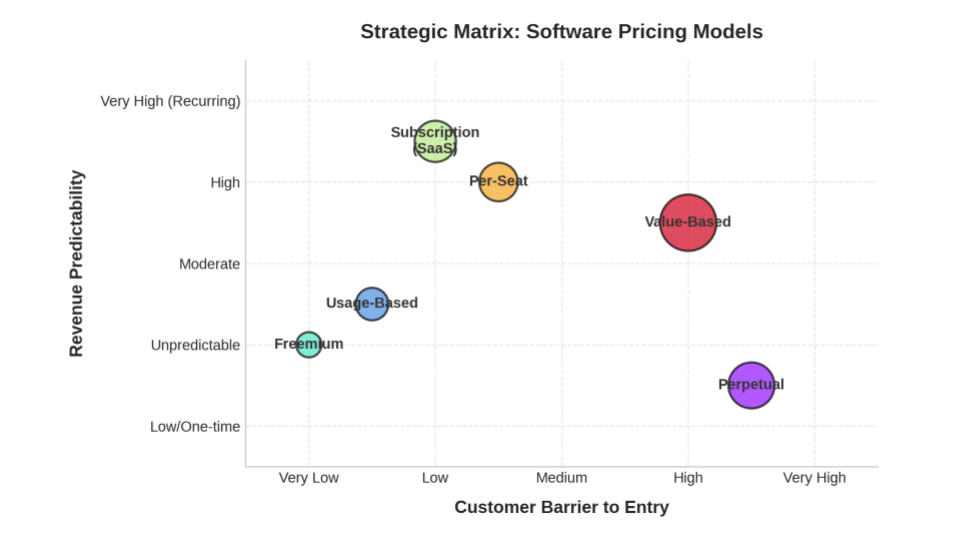
In today's mature tech ecosystem, pricing is no longer just a sticker on a landing page—it is a core component of your product strategy. Let's dive into the six classic frameworks that drive the industry, how they balance barrier to entry against revenue predictability, and when to deploy them.
Subscription
(SaaS): The Predictable Engine The undisputed heavyweight champion of modern software. Customers pay a recurring fee—usually monthly or annually—to maintain access to the platform. Because the software is hosted in the cloud, users always enjoy the latest version without manual upgrades.
Best For: Cloud-native tools, mission-critical workflow apps, and platforms requiring continuous updates and support.
The Advantage: Highly predictable Annual Recurring Revenue (ARR), compounding growth, and strong valuations from investors.
The Risk: High churn if the product fails to deliver ongoing, daily/weekly value. You have to win the customer's business every single month.
Usage-Based
(Consumption): The Ultimate Alignment Instead of a flat recurring fee, customers pay strictly for what they consume. Whether it is gigabytes of storage, API calls, processed payments, or active compute hours, the billing scales frictionlessly with the customer's internal usage.
Best For: Developer tools, infrastructure platforms (AWS, Snowflake), communications APIs (Twilio), and fintech gateways (Stripe).
The Advantage: Zero friction for early-stage adoption. As your customers grow into massive enterprises, your revenue expands automatically without needing a contract renegotiation.
The Risk: Revenue can be highly volatile and subject to macroeconomic pullbacks. If a customer optimizes their code, your revenue might drop overnight.
Freemium
The Product-Led Growth Funnel Offer a genuinely valuable, stripped-down tier of your product entirely for free. Once users hit a specific utility ceiling—such as storage limits, advanced security requirements, or premium team collaboration tools—they are prompted to upgrade to a paid tier.
Best For: Consumer apps (Spotify), bottom-up B2B productivity tools (Zoom, Notion), and high-virality software. ** The Advantage:** Drastically lowers Customer Acquisition Cost (CAC). The product itself serves as your primary marketing engine. ** The Risk:** Free users cost money to host and support. If your conversion rate to paid (typically 2% to 5%) is too low, the free tier will bleed your resources dry.
Per-User
(Seat-Based): The Expansion Play Billing is tied directly to headcount. Companies pay a set price per month for every employee provisioned on the platform. It is clean, easy to understand, and aligns nicely with team expansion.
Best For: CRMs, communication hubs, and collaborative design tools (Salesforce, Slack, Figma). ** The Advantage**: Clear, linear expansion. Selling into a 10-person startup that grows into a 1,000-person enterprise yields a 100x revenue expansion naturally.
The Risk: Encourages 'seat-sharing' (multiple users logging into one account) if not strictly enforced. It can also cause friction during enterprise-wide rollouts.
Value-Based Pricing: The Enterprise Heavyweight
Decouple your price completely from your development costs or your competitors' pricing. Instead, calculate the exact, quantifiable economic impact your software delivers to the client, and charge a percentage of that created value.
Best For: Highly specialized enterprise software, AI automation suites, and niche vertical tools solving multi-million dollar inefficiencies.
The Advantage: Maximum margins. If your software saves an industrial manufacturer $10 million a year, charging them $1 million annually is highly justifiable, regardless of what it cost you to build.
The Risk: Requires highly sophisticated, lengthy sales cycles and deep consultative discovery to prove the ROI upfront.
Perpetual Licensing: The Legacy Anchor
The traditional 'buy it once, own it forever' model. Customers pay a large upfront capital expenditure to secure a license for a specific software version. Often paired with an optional annual maintenance contract (typically 15-20%) for updates and support.
Best For: On-premise enterprise deployments, highly regulated industries (defense, banking) with air-gapped systems, and heavy creative suites.
The Advantage: Massive immediate cash flow upon closing a deal.
The Risk: Lacks the highly valued compounding predictability of recurring SaaS models. Forces companies to constantly hunt for new deals rather than building a stable baseline.
| Strategy | Primary Goal | Revenue Flow | Adoption Friction |
|---|---|---|---|
| Subscription (SaaS) | Retention & LTV | Highly Predictable | Low |
| Usage-Based | Volume Scaling | Variable / Elastic | Very Low |
| Freemium | Viral Growth & Top-of-Funnel | Mixed / Conversion-dependent | Zero |
| Per-Seat | Team Expansion | Predictable (Linear) | Medium |
| Value-Based | Margin Maximization | High per Contract | High (Complex Sales) |
| Perpetual | Upfront Capital | One-time Spikes | High (Capex) |
Which pricing strategy has been the most effective for your product? Are you seeing a shift toward usage-based billing in your vertical, or does flat-rate SaaS still reign supreme? Let's discuss in the comments above!