ANNs vs SNNs
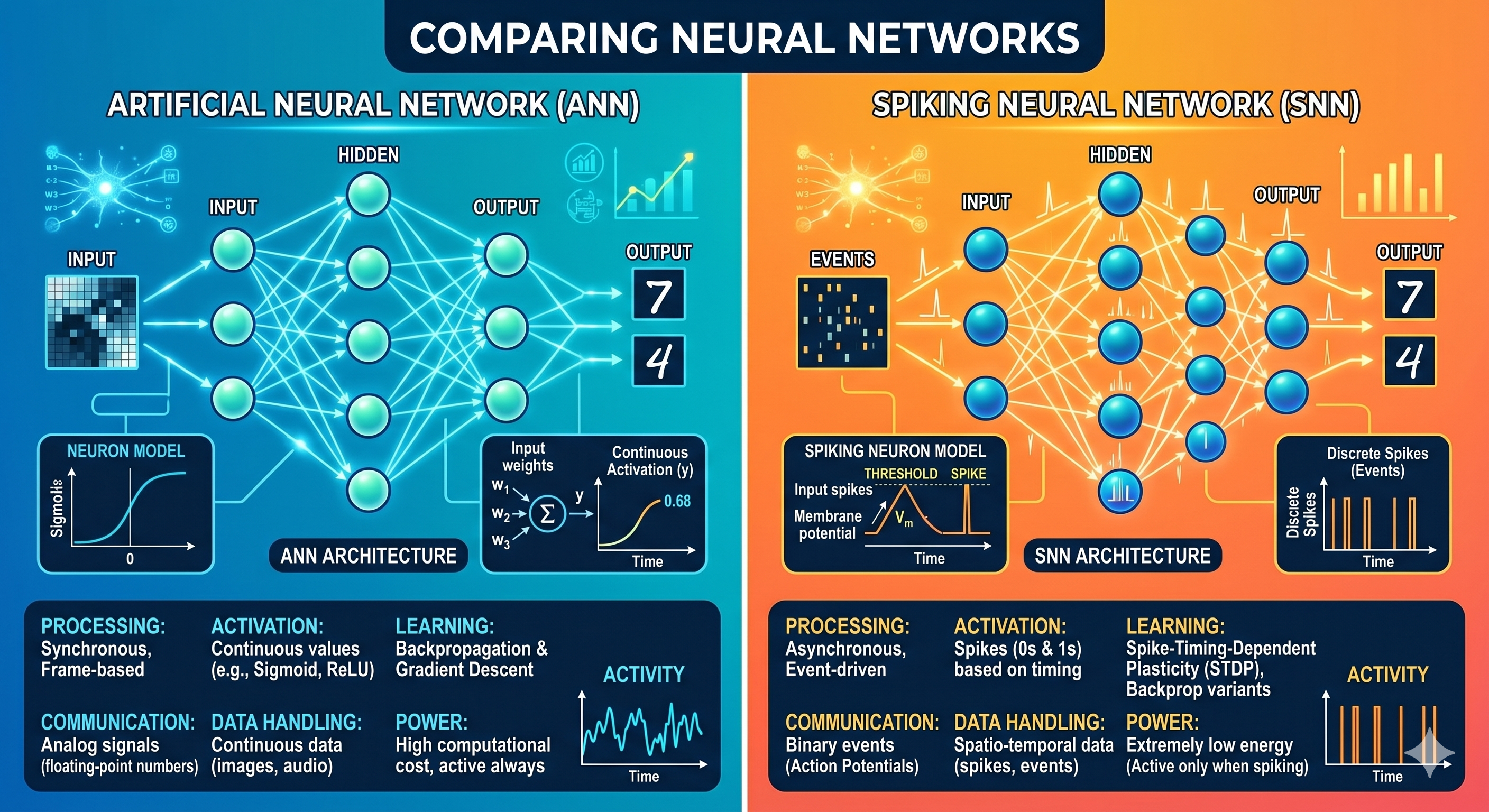
While the architectures we've discussed so far (CNNs, Transformers) are technically types of Artificial Neural Networks (ANNs), distinguishing between standard ANNs and the newer Spiking Neural Networks (SNNs) is where we see the future of energy-efficient AI.
The Foundation vs. The Future: ANNs and Spiking Networks
Artificial Neural Networks (ANNs)
The Industry Workhorse
ANNs are the umbrella category for almost everything in production today. They use continuous mathematical values (0.1, 0.5, etc.) to pass information through layers.
Benefits: Unrivaled Accuracy. Because they use smooth, continuous data, we can use "backpropagation" (the math that allows AI to learn from its mistakes) very effectively. They are compatible with almost all current hardware (GPUs/TPUs).
Costs: Power Hungry. ANNs are "always on." Even if only 1% of the data is relevant, every neuron in a layer typically performs a calculation. This leads to massive electricity and cooling costs in data centers.
Popular Applications:
- Enterprise SaaS: Lead scoring, churn prediction, and recommendation engines.
- LLMs: The "Reasoning" engines we use in daily chat interfaces.
Spiking Neural Networks (SNNs)
The Energy Disruptor
SNNs are "Third Generation" neural networks. Instead of continuous values, they communicate via spikes—discrete electrical pulses that only fire when a certain threshold is reached, exactly like a human brain.
Benefits: Extreme Efficiency. SNNs are event-driven. If there is no new data, the neurons stay silent, consuming near-zero power. They can be up to 100x more energy-efficient than traditional ANNs when run on specialized "neuromorphic" chips (like Intel's Loihi or Darwin3).
Costs: The Training Gap. Because spikes are "on/off" (non-differentiable), the standard math we use to train AI doesn't work well here. We are still in the early days of "ANN-to-SNN" conversion tools to bridge this gap.
Popular Applications:
- Edge AI & IoT: Battery-powered sensors that need to run for years without a charge.
- Neuromorphic Vision: Cameras that only process "change" (motion) rather than full frames, ideal for high-speed robotics.
- Brain-Machine Interfaces: Implants that need to "talk" to biological neurons in their own language.
Cost-Benefit Analysis: The Efficiency Trade-off
| Network Type | Data Type | Energy Usage | Hardware Requirement | Best For |
|---|---|---|---|---|
| Standard ANN | Continuous / Dense | High | Standard GPUs/TPUs | High-precision Cloud AI |
| Spiking (SNN) | Discrete / Sparse | Ultra-Low | Neuromorphic Chips | Always-on Edge Devices |
Why This Matters for 2026 Strategy
As we move toward Agentic AI—where models aren't just sitting in a data center but are living on our phones, wearables, and in our cars—the energy bottleneck becomes a business bottleneck.
For Founders: If your product requires "always-on" listening or vision, building an SNN-based pipeline could be your primary competitive advantage in battery life and unit economics.
For Investors: Keep an eye on the "Silicon-to-Brain" bridge. Companies successfully converting ANN performance into SNN efficiency are the ones that will dominate the $100B+ Edge AI market.
The "vibe" is shifting from "How smart can we make it?" to "How smart can we make it on 5 milliwatts?"